
ENGLISH PASTORAL
Updated: Dec 10, 2024
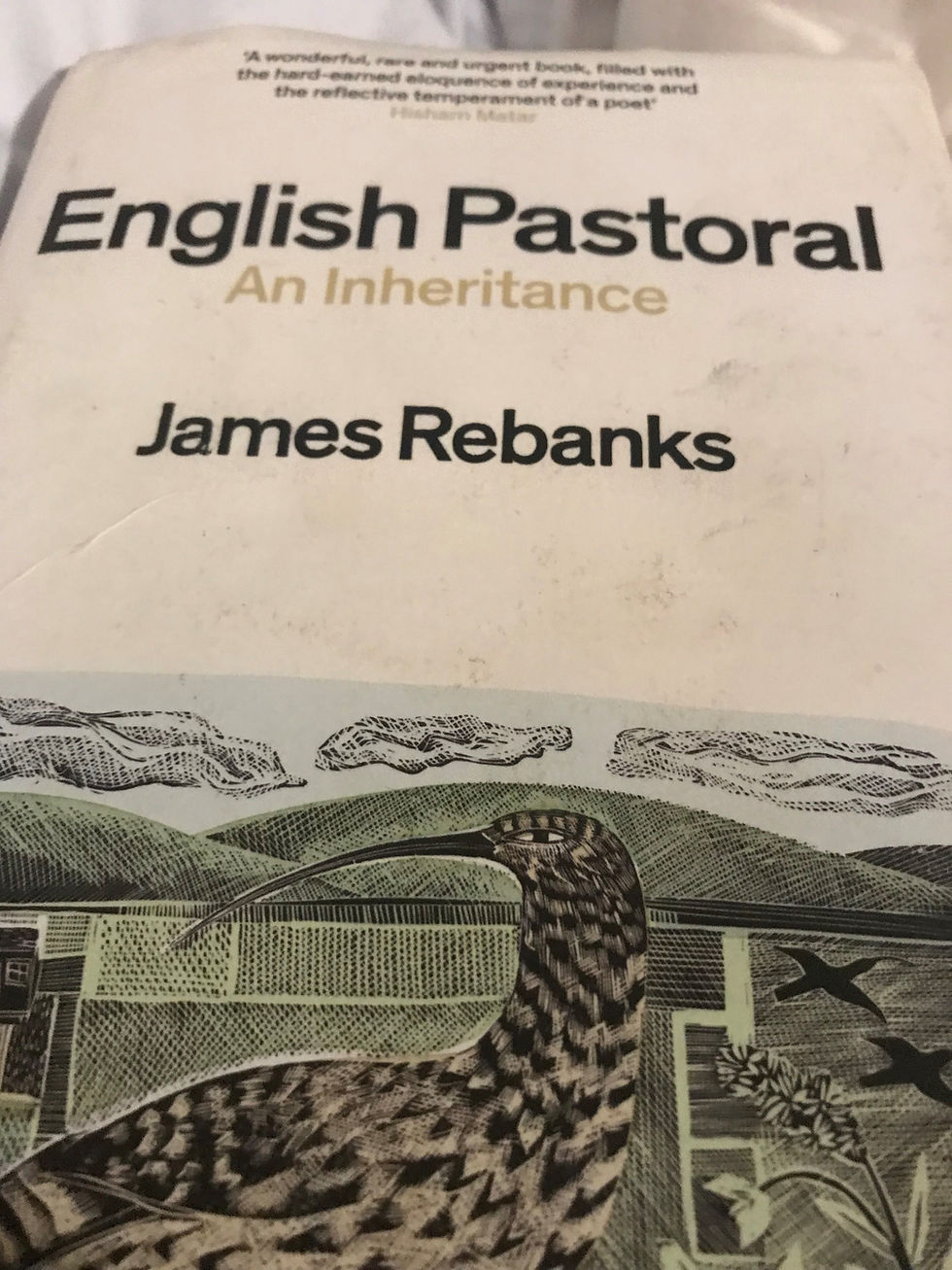
English Pastoral by James Rebank. Based in a rural farm in England’s Lake District, this book is about the author’s struggle as a farmer as he traces his story from being a child learning at his grandfather’s side, (partly due to a difficult relationship with his father) to becoming an adolescent thinking he knows more than them both. His grandfather then passes away and he worked alongside his father until he also passed on and finally James takes on the responsibility of maintaining the farm himself. Not as easy as the adolescent James thought!
We read of the old ways his grandfather taught him, his enthusiasm and then struggles with modernity and adapting to a new world, his realization of how that was making a terrible impact on the soil and sustainability of his farm. He links this realization with a rejection of an economics which heralds ‘efficiency and productivity’ above all natural capital. The book ends with him expressing a pretty dim view of a single capital economist view of agriculture, failing as it does to consider sustaining the earth and bio-diversity – on which all agriculture depends. Then he meets an ecologist (stating initially he was extremely sceptical) until he is won over and sees how much he can still learn about his farm! Finally we see him forging a hybrid approach between habitat conservation, modern farming and traditional methods.
James is no rural farming traditionalist. In his other book, The Shepherd’s Life, he explains how he studied at Oxford and so this book combines, through his gift of story-telling, history, economics, the rise in production, pesticides, large-scale farming and much more. He also has a lovely turn of phrase.
I couldn’t help but feel it resonates with us here in A Rocha: he captures the sense of balance and care for all living things that I find embodied in our A Rocha Commitment to Creation Care; He advocates a simple life and critiques so many flaws in our current global system (which at times got me quite depressed) but like all good prophets he does more than bemoan the current state (that would just make him a whinge-bag) - he goes on to paint a vision and give us a hope. It’s a story which connects his small farm to living creatures and birds (who in turn are linked via their migrations to other parts of the world) farmers and mouths they feel burdened to feed, the community of people who he acknowledges so help and sustain farm life, and a long-lasting soil on which insects, animals, crops and human-kind ultimately depend.
Although James does once quote the Old Testament (to show how God instructed the Israelites in their attitudes to farming), he shows no sign of any faith nor even really gives even a nod to Christianity. Yet I can’t help he paints a vision aligned with that we find in the Bible. If Eden signifies a world where humans live in harmony with their God, each other, all living creatures and their land and the purpose of Christ’s mission is to renew all things to such glory (giving a foretaste of heaven on earth) – then actually James seems to have got pretty close to working it out….and is certainly striving for such!
Worth a read!
PS: Written largely in ignorance about farming.
PS: Written largely in ignorance about farming.
PPS – after writing the above I happened to be travelling through rural India which reminded me a bit of the UK in the 1960s (not that I was alive then): smaller fields, some tractors, but small scale animal life intermingled with the land and crops…..and everywhere was a variety of butterfly and birds….I even spotted my first ever Roller – fairly sure it was the India roller!


Comments